Loading...
All Posts By

Jeneba Jalloh Ghatt

How Halloween Offers Holiday Traditions for Kids in Secular Households

Guest Post

by Maria Polonchek

I don’t remember how my husband Chris and I ended up with six-month-old twins dressed as vegetables—a chili pepper and a pea pod, to be precise—the first Halloween we were parents. I’ll admit the whole thing sounds very much like the result of a middle-of-the-night-nursing and Internet-browsing session. Regardless, they were pretty cute, as far as produce goes, and we wanted to show them off. At the last minute, we decided to throw on overalls (an article of clothing every good Kansan should own), dress as farmers, and take the veggies downtown, where we’d heard there was annual storefront trick-or-treating.

We did not head out the door that night intending for Halloween to become our family thing. In our Midwestern college town, we discovered, students ranging in age from preschool to graduate school flock downtown to the local businesses, who open their doors after hours and hand out candy from cauldrons and wheelbarrows. Everyone dresses up and the restaurants overflow with happy witches and silly superheroes, nibbling candy, drinking beer, eating French fries. Neither of us had participated in the festivities before becoming parents but realized, at least in this town, you’re never too old to be something for Halloween.

For the next five years, the downtown trick-or-treat tour was tradition, and our family’s passion for Halloween blossomed. While the twins were young, we dressed in themes: the farmers and veggies, Dr. Seuss characters, a family of pirates. Within a few years, though, the boys were ready to fulfill their own costume visions and left Chris and I on our own to coordinate. Halloween became our immediate family’s most consistent annual tradition, the holiday we made our own. The summer we moved to California, I had a harder time thinking of being away for Halloween more than any other day.

Chris and I are raising our children outside of religion, which is not unlike relocating to a new place: it’s both liberating and daunting to be free from constraints that inform our rituals and traditions. On the one hand, the possibilities are endless. We can determine for ourselves what values we want to express, what connections we want to nurture, and when, where, and how we do it. On the other hand, precisely because the possibilities are endless and we can make adjustments, we may notice “tradition” lacking in qualities that help define it: predictability, commitment, endurance.

It’s worth taking on the challenge: a whole body of research points to the fact that rituals and traditions benefit children in a number of ways, including academically, emotionally, and socially.  As I’ve seen first hand, being able to count on a predictable set of behaviors and activities around certain landmark dates brings children a sense of stability and security. Opportunities to contribute to these activities helps kids feel useful and needed, shaping identity and a sense of purpose. Participating alongside family and community members, regardless of differences in age and lifestyle, combats sentiments of self-centeredness and encourages empathy and generosity — all while creating lasting memories of positive emotions. It seems important, then, for all families, religious or not, to find meaningful traditions of their own.

We’d begun our Halloween tradition haphazardly, out of convenience more than anything else, as the logistics—who, what, when, where, how—were already answered for us. We didn’t really need to think about it; we just showed up to a party that had already been planned. Over time we developed an approach that stuck, one we could emulate even after we moved away from our familiar environment near family.

Thus I realized: holidays like Halloween, with little or no religious baggage, are the perfect occasions for creating solid family traditions outside of religion. Thanksgiving is another great example. It can be tricky to come up with a formula for creating tradition outside of the mainstream. I’ve learned, though, that creating new traditions can be a celebration of creativity and imagination.

Below are my suggestions for how to navigate the ins and outs of creating meaningful traditions for your family, with or without religion:

  • Pick your occasions. Take a look at some of the activities and holidays your family has already established as routine. Ask your children what parts they enjoy and why. Consider what the activity expresses about the group and how each person can participate. Whether it’s Valentine’s Day, the summer equinox, or even Superbowl Sunday, make your picks and stick with them. Ritual and tradition is not so much what you do; it’s how you do it, together: with regularity, intention, and commitment.
  • Own it. Reflect on your values and the things that give your family life meaning so that you are fully behind the actions. Consider the historical and/or philosophical reasons and meanings behind established traditions and create versions of your own to honor those that resonate. If you notice something lacking—an activity that expresses generosity or service, for example—come up with an activity that reflects this value and fold it in.
  • Make room for others. Traditions are connectors; they link us to one another, which requires patience, understanding, and compromise. Remember, just as we don’t always resonate with traditions from past generations, so our children won’t always resonate with ours. Participating in tradition can be a practice in selflessness and acceptance.
  • Allow for flexibility. While a defining component of tradition is its predictability, we also must allow for (and even embrace) change and differences. The level of flexibility needed won’t be the same for every family. Perhaps the location is always different, but the activity is the same. Or the location is the same, but some of the people participating rotate. Families who struggle with differences in worldview or belief can still come together to celebrate shared values in creative ways that work for everyone.
  • Be committed. Because tradition can serve as a touchstone in times of change and difficulty, it’s important to keep it going even when the going gets rough. It can sometimes feel like pressure or burden on the leaders of the group, but if you’re struggling, take a moment to reflect on the benefits, talk to your kids about what they find meaningful, and make adjustments that work for the entire family.

About the Author

Maria Polonchek is author of In Good Faith: Secular Parenting in a Religious World (Rowman & Littlefield Publishers, August 2017). Part memoir, part cultural exploration, In Good Faith examines how to raise children with a sense of identity, belonging and meaning outside of religion. Maria holds a BA in English and an MFA in Creative Nonfiction from the University of Kansas. Her parenting essays can be found in outlets such as Brain, Child, Have Milk, Will Travel, The Greater Good Science Center, The Friendly Atheist and Brian, Mother. A Kansas native, she lives in the San Francisco Bay Area with her husband and three children. In addition to thinking, reading and writing about parenting, she is passionate about wellness, mindfulness, the outdoors, music, art – and the way all of these things relate to social justice.


Report: Black Women in Texas Are Dying From Pregnancy and Child Birth at an Alarming Rate

A recent United Nations-funded in-depth report in the LA Times this week state that black women in Texas are dying from pregnancy and childbirth at an increasingly alarming rate. These following passages stand out:

Every year, around 700 women in the United States die as a result of pregnancy or delivery complications. As many as 60,000 expectant mothers suffer problems that come close to costing them their lives.

America is one of the most developed nations in the world. Average life expectancy has been generally increasing over at least the last five decades, and deaths from illnesses that were once widely fatal, including polio, small pox, tuberculosis and AIDS, are sharply falling.

Yet when it comes to the natural process of childbearing, women in the U.S. die in much higher numbers than those in most developed nations, where maternal deaths are generally declining.

A woman in the U.S., where the maternal death ratio more than doubled between 1987 and 2013, is more likely to die as a result of pregnancy-related causes than in 31 industrialized countries of the Organization for Economic Cooperation and Development, aside from Mexico.

There are various theories why — persistent poverty, large numbers of women without adequate health insurance, risk factors related to stress and discrimination. All come together here in Texas, with a twist that has become one of America’s most confounding public health problems: African American women are dying of pregnancy- and childbirth-related causes here at stunningly high rates.

The maternal death rate in Texas after 2010 reached “levels not seen in other U.S. states,” according to a report compiled for the American College of Obstetricians and Gynecologists, based on figures from the U.S. Centers for Disease Control.

Black women in Texas are dying at the highest rates of all. A 2016 joint report by Texas’ Maternal Mortality and Morbidity Task Force and Department of State Health Services found that black mothers accounted for 11.4% of Texas births in 2011 and 2012, but 28.8% of pregnancy-related deaths.

“This is a crisis,” said Marsha Jones, executive director of the Afiya Center, a Dallas-based nonprofit that has taken on the issue. In May, the center published its first report: “We Can’t Watch Black Women Die.”

continue reading the entire piece. It’s worth it.

Vicky Secret Model Behati Prinsloo Sizzles in Bump Hugging Minidress

Grrrrrr!!

Electrifying Victoria Secret model Behati Prinsloo posted a Bump progression photo via her Instagram account this week. Wednesday.

“Got myself out of my maternity jeans just to celebrate the very talented @hungvanngo. LOVE YOU, you deserve it all. Thanks @instylemagazine for a beautiful dinner glam: @cwoodhair  @michaelashton styled by me,” she captioned the mirror selfie of herself in a super cute bump-hugging leopard print mini dress with  black pumps.

She looked awesome and healthy! Looks like she is having a great second pregnancy so far.

The African model and Adam Levine, Maroon 5 frontman, wed in 2014 and  welcomed daughter Dusty Rose last September.

How To Get Your Co-Dependent Child To Be More Independent

You’ve heard of or perhaps have had a baby, child or other person who has a very difficult time separating from you as a caregiver. It may be very challenging to get that person, especially an infant or toddler who needs to be left at a baby sitter, to cope without you and become more independent.  Ilene Dillon, LMFT, LCSW, author and life coach offered some tips to our partners at eNannySource who asked us to share the tips with our family readers:

 What is co-dependence?

Ilene: There is no one who can get more tired than someone caring for a young infant. Why is this? It’s because infants are totally helpless and need someone to care for their every need in order to survive. Not only does the caretaker have to do the caring, but s/he must figure out what the child needs as well. This is much more difficult to do than we think, especially when your infant is uncomfortable and screaming!

When your child is an infant, you are willing to have that individual “use you,” taking up your time, your emotions, your energy and your caring. This is the design of things. We are all born co-dependent, meaning we need to have someone (I call that person an “energy broker”) who helps us exchange what we need with the world. As infants, this means getting messages about what is needed “out,” while also getting what is needed to be “brought in” by the “broker.” We parents love our little babies and realize that this broker position is part of the deal—it’s what our child needs in order to survive and begin to grow up. We allow our baby to manipulate us (note that I use two other terms interchangeably with co-dependence:  manipulation and energy-sapping). And even though we may get tired, we love it!

What does this look like when your child is 53 years old, however, and is still expecting another person (a broker) to allow the use of that individual’s energy for whatever your adult child needs to exchange with the world? It’s not pretty. Lots of people want to tell this person to “grow up”! Co-dependence is a term that has been developed to describe this condition: when an adult-appearing individual utilizes another adult’s energy, usually without conscious agreement from the broker. I call a person behaving in this way a “Lifestyle Energy Sapper,” one who knows of no other way to live than to live enmeshed with other people, needing them to be a part of whatever that individual is doing in the world.

Interestingly, most people with whom I have discussed co-dependence believe that it is “normal.” I do not agree. I believe that humans are designed to grow out of co-dependence, just as we grow out of bed-wetting. Sadly, most parents have not been apprised of this possibility, and so they don’t offer the help children need in order to grow past co-dependence. We have accepted that “everybody manipulates,” not realizing that manipulation may be common, but it’s not really “normal”!

eNannySource:  When do children begin to grow out of it?

Ilene: Remember when your two-year old was announcing “me do it myself!”? Two year olds are driven to begin growing out of co-dependence. Unfortunately for them, however, their body and brain have not yet developed to the point where they can put energy mainly through themselves. They still need a broker for a while.

Somewhere between the ages of 3 and 4, a child develops the ability to ask for what s/he wants, to pull the blanket up to keep warm, to get a glass of water on his/her own and to do a lot of things without needing to have a broker manage the exchange. They’re not perfect at this yet, but it’s the time humans can begin to grow out of energy-sapping and move toward adulthood. As childhood goes on, that child is designed to take on more and more of the responsibility for exchanging energy directly with his/her world.

Babies “need” another person to act as a broker; without such a broker they will die. Adults, on the other hand, “want” to have others be with them, give to them and work on their behalf, but without such behaviors from other adults, they will still survive. The difference between a co-dependent person and an adult is this very difference between “need” and “want.”

eNannySource:  What things hamper a child’s independence?

Ilene: Parents usually miss helping their child grow out of co-dependence for three reasons. First, they don’t know that children need help with this part of life, so they don’t give it. Second, they believe that asking a small child to start taking responsibility for his/her life is too much (even when the child takes over this responsibility gradually). Third, they are themselves manipulative (never grew out of it), and therefore feel they “need” to stay enmeshed with their children, not at all wishing those children to develop independence.

These are the biggest reasons children have difficulty becoming independent, too. Couple them with the fear most parents have about children being kidnapped, sexually abused or hurt, and parents begin to hover in the style that has been called “helicopter parenting.” This style of parenting can cripple children for life, even though the parents are operating from loving concern. Hara Moreno, an editor for Psychology Today magazine, has written A Nation of Wimps, an exposition of what this costs our children and our democracy. Being fearful, helicopter parents who don’t allow our children independence also robs them of their ability to make good decisions and develop confidence in themselves.

What can parents do to help them grow out of it?

Ilene: To help our children grow out of co-dependence, we need to 1) Realize they need our help. 2) Encourage our child(ren) to take as much responsibility as they want to or can (without heavy overload), realizing that responsibility is one of the primary building blocks of self-esteem, and that all children experience a drive to be in charge of their own lives and choices. We can partner with our children on this, allowing them to be independent decision-makers, based on their capability and level of development. 3) Address our own co-dependence, moving ourselves to “want” from others, but not to be in “need” of others for our well-being in our own lives.

What are your best three tips for raising independent children?

Ilene: Ultimately, parents want to raise children to live comfortably both independently and inter-dependently.

There are three good ways to do this. 1) Encourage your child to make decisions from the very early years, managing the early-years decisions by giving only two possibilities at a time, and gradually allowing more choices as your child matures. 2) Allow your child to make mistakes. Celebrate the mistakes as well as the great decisions. Jim Fay (Love and Logic Institute) says he is happy when he learns that a child has made a mistake because he knows that child is in process of learning something!  3) Review choices your child has made with him or her, determining whether the outcome is what s/he desires. If it is not, guide your child in making and testing a new choice. This will build your child’s confidence in his/her ability to make decisions and trust his/her judgment!

 Is there anything else you’d like to share?

Ilene: Many people believe manipulation is harmless. It is not. When individuals grow bodies that look adult, but are operating emotionally like a three year old (which is what happens when we don’t grow out of manipulation), their lives can become very painful. They are easily involved in abusive relationships, for example. Abusive relationships result when two people are so fearful of being separate (independent) that they remain in situations where they are not treated well.

Therapists do not work with abuse perpetrators and victims in the same therapy sessions, usually, because it is so difficult to determine who really is the perpetrator and who really is the victim! When we have two individuals who are afraid they won’t survive if they don’t hang on to that other person, each becomes helpless and ineffectual. To make up for this, they attempt to control each other. Nobody likes to be controlled, so anger develops. You can see the loop of abuse and co-dependence developing as I describe the scenario. As a parent, you can protect your child from getting into abusive relationships by assisting them to grow out of co-dependence, as humans are really designed to do!

Then, your child will become an adult who is comfortable being alone as well as being together with partners. S/he will be able to set clear and firm boundaries, which in turn allows for greater intimacy and closeness. Your adult child will feel confident, be able to trust his/her judgment and know what good decisions s/he is capable of making. You’ll be delighted to have raised a child to adulthood who can stand tall, be emotionally self-reliant, and who still is able to connect deeply with others.

Need Weekend Looks? Try My Celeb Faves

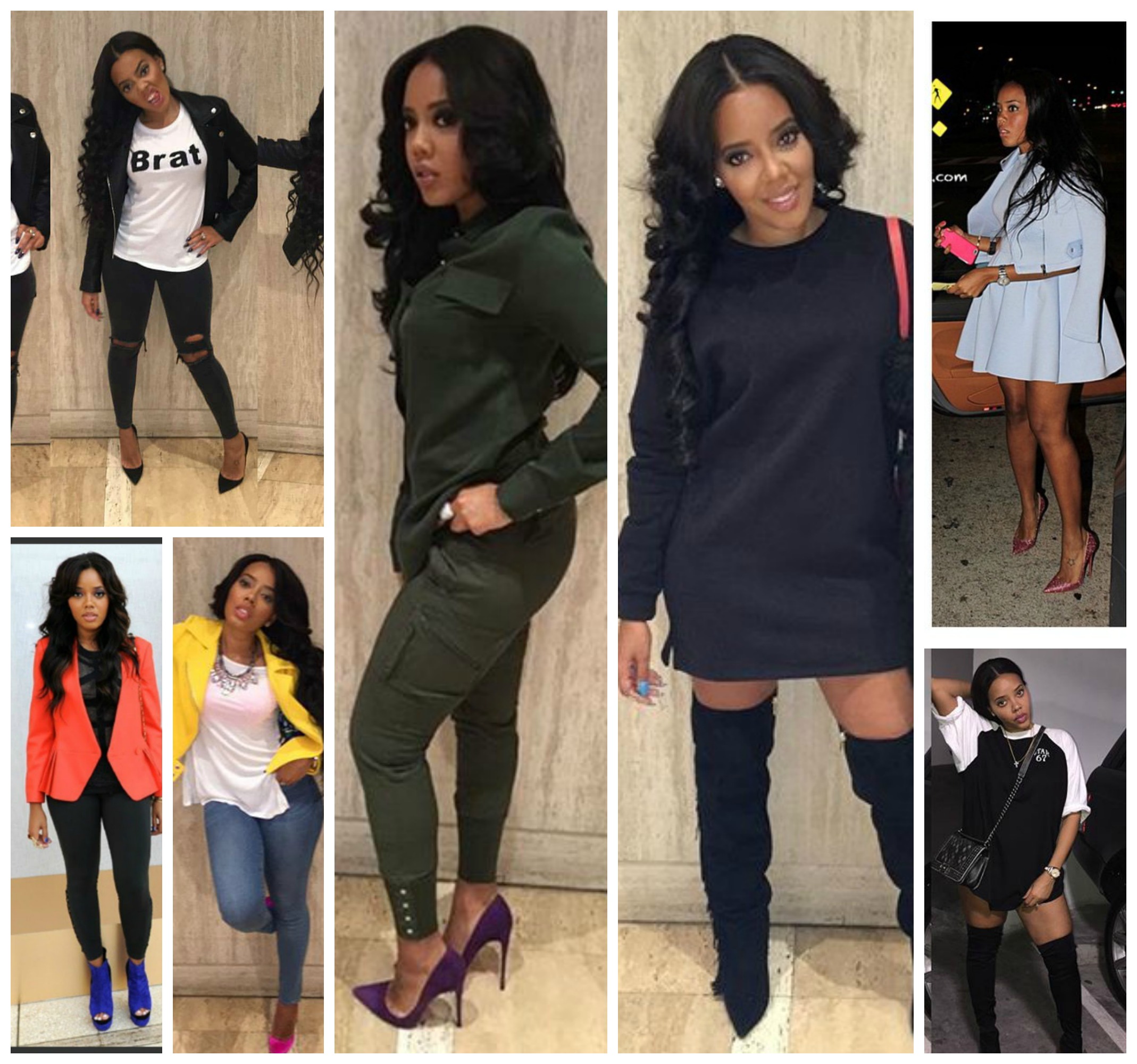
I’ve decided that Bellyitch Bumpwatch alums Growing Up Hip Hop‘s Angela Simmons and Love and Hip Hop:New York‘s  Rasheeda are my fashion spirit animals.

Maybe it’s the fact that I think Simmons and I have similar body shape and height as hers and I love how she experiments with color and embraces blazers, colorful pumps but still rocks her army green and black all day. She does figure hugging body con and sporty Athletic Baseball dresses well.

With Rasheeda, she’s that edgy wild child that I am in my mind. No one can rock a lace up gladiator boot like this mama! She’s also queen of the distressed denims and funky and edgy rocker tee worn under a cute camo jacket or stone or acid washed coat jacket.

They’re definitely fashionable moms after my own heart and they are also hustlers. Each sell clothing, do club appearances and star on reality TV shows and got their hustle game on! Love!

Shop their looks:

Answer to ‘Why Do I Still Get Heartburn After Having My Baby?’

You thought your pregnancy heartburn would stop after you gave birth, but your kid is now a toddler—and heartburn is still causing you pain. Here are some reasons why the condition may be persisting, and what you can do to fix it.

Nearly all moms know about pregnancy heartburn. But now that baby’s walking, talking—and maybe already in school!—you’re still battling the burn. What gives? As it turns out, some common habits of motherhood can lead to acid reflux or even make those symptoms worse. Read on to learn what’s behind that burning feeling in your chest, and what you can do to put out the flame.

1. It takes a large coffee or tea (or two) to get through the day. Some experts think that the caffeine in that cup of joe relaxes the muscle at the top of the stomach, which allows acid to wash back up, causing heartburn. However, other research has been inconclusive. If you want to play it safe, try an all-natural perk-me-up instead of coffee: Hit the stairs. One study of people who regularly didn’t get enough sleep found that that subjects who climbed stairs for just a couple of minutes had the same energy boost as if they’d chugged a cup of coffee.

2. Between school drop-off and soccer practice, your schedule feels like a race. Juggling a million things can put you on high alert. This can flood your body with stress hormones, which may raise your risk for acid reflux. Research shows that stress can trigger heartburn. Make time in your schedule to decompress, even if it’s just five minutes of deep breathing.

Continue readin

Answer to ‘I’m No Longer Pregnant So Why Do I Still Have Heartburn?’

You thought your pregnancy heartburn would stop after you gave birth, but your kid is now a toddler—and heartburn is still causing you pain. Here are some reasons why the condition may be persisting, and what you can do to fix it.

Nearly all moms know about pregnancy heartburn. But now that baby’s walking, talking—and maybe already in school!—you’re still battling the burn. What gives? As it turns out, some common habits of motherhood can lead to acid reflux or even make those symptoms worse. Read on to learn what’s behind that burning feeling in your chest, and what you can do to put out the flame.

1. It takes a large coffee or tea (or two) to get through the day. Some experts think that the caffeine in that cup of joe relaxes the muscle at the top of the stomach, which allows acid to wash back up, causing heartburn. However, other research has been inconclusive. If you want to play it safe, try an all-natural perk-me-up instead of coffee: Hit the stairs. One study of people who regularly didn’t get enough sleep found that that subjects who climbed stairs for just a couple of minutes had the same energy boost as if they’d chugged a cup of coffee.

2. Between school drop-off and soccer practice, your schedule feels like a race. Juggling a million things can put you on high alert. This can flood your body with stress hormones, which may raise your risk for acid reflux. Research shows that stress can trigger heartburn. Make time in your schedule to decompress, even if it’s just five minutes of deep breathing.

Continue reading

Cristiano Ronaldo’s Girlfriend Georgina Rodriguez Debuts Bump

International soccer star Cristiano Ronaldo and his fiance Georgina Rodriguez hit the red carpet this week in London to celebrate his Fifa Player of the Year award.

It has been the first official public appearance of the couple that are expecting their first child together in a little over a month. Ronaldo’s son Ronaldo Jr attended the event held at the London Palladium in the capital’s trendy West End.

He beat rivals Lionel Messi of Barcelona and Paris Saint-Germain‘s Neymar to top honors for the second year in a row.

Rodgriquez looked stunning in a metallic silver wrap dress with soft make up and loose waves.

h/t The Sun

The 7 Things to Do to Have More Peaceful Holiday Gatherings

As the holidays approach we all think about the conversations we are going to have.  Those we look forward to having and those thrust upon us.  How do we talk about the year in review?  Hot button political questions?  Hurricanes? Fires?

The Art of Connectionby Michael Gelb is a guide to creating, and maintaining, genuine rapport with others. Connection is the research validated secret of happiness, health and longevity, and it’s also especially relevant on a personal basis as we approach the Holiday season.  Gelb leads seminars for corporate teams to help them communicate more effectively, but, as he emphasizes, these same skills may be even more important in dealing with family and friends.

Gelb outlines seven skills distilled from decades of practical experience.

  1. Embrace Humility — Why humility is the source of genuine strength and confidence, and how to cultivate it. (Be open to seeing your chatty Aunt Edith in a new light.  Ask her some questions.  What’s her earliest Thanksgiving memory?  What is she most grateful for? How did she develop her recipe for stuffing?)
  2. Be a Glowworm — How emotions are contagious and how to spread the energy to bring out the best in yourself and others.  (Thanks to mirror neurons others will reflect and magnify the attitudes you manifest.  If you choose an uplifting, grateful attitude and look for the best in everyone, even your estranged ex, you may be surprised to discover that the atmosphere becomes more positive.)
  3.  Achieve the Three Liberations — Profound ways to shift out of patterns that interfere with your ability to connect with yourself and others. (Most important here is to let go of taking anything personally, refrain from the temptation to complain or commiserate and suspend your automatic judgments of everyone and everything.  This liberates way more energy to enjoy the turkey, the football game and all your relatives.)
  4. Transcend Fixations — Move beyond the habits that limit your freedom to connect and respond intelligently and effectively, to different types of people. (When we realize that most of people’s behaviors are hard-wired expressions of their personality typology it’s much easier to be compassionate and not take things personally.)
  5. Balance Energy Exchange — Methods to monitor the balance of energy in relationships and adjust when necessary. (As Wharton Professor Adam Grant advises focus on being “otherish”…little acts of kindness make a big positive difference)
  6. Be a RARE Listener — How to improve your real listening skills right now.  (The Holidays are a wonderful time to practice ‘empathic listening.’
  7. Turn Friction into Momentum — What you need to transform your approach to conflict (Unlike the football game you may be watching, a conflict isn’t a contest.  It’s an opportunity to find creative solutions to meet your needs and the needs of others. Think creatively about new ways to relate to the people who get on your nerves.)

These skills are all timeless, but they are also especially timely.  Each chapter includes illustrative stories, relevant scientific research, and practical exercises to help readers apply the skills in their life today.

Michael J. Gelb has pioneered the fields of creative thinking, accelerated learning, and innovative leadership. He leads seminars for organizations such as DuPont, Merck, Microsoft, Nike, and YPO.  He also teaches at the University of Virginia’s Darden School of Business and the London Business School. He is also the author of How to Think Like Leonardo da Vinci and several other bestsellers. His website is www.MichaelGelb.com.


Model Bar Refaeli Welcomes Second Child, Daughter Elle

Congratulations are in order for Bar Refaeli and Adi Ezra.

The supermodel, 32, and her billionaire businessman husband, 42, welcomed their second child — daughter Elle — on Friday (October 20) in Israel, PEOPLE reports.

The newborn joins the couple’s 14-month-old daughter Liv.

“Our hearts are full of love right now, as I am excited to announce I am a mom of two,” gushed the model in a statement.

“We welcomed Liv’s little sister, Elle, into the world on Friday, Oct. 20 at 8:50 p.m, weighing 3 kilos. We are all happy, healthy and eager to start this new chapter in our lives,” she added.”

The couple — who wed in September 2015 in Haifa, Israel — announced their second pregnancy in March.

continue reading

Batman138 Bro138 Dolar138 Gas138 Gudang138 Hoki99 Ligaciputra Panen77 Zeus138 Kilat77 Planet88 Gaspol168 Sikat88 Rupiah138 Garuda138 Gacor77 Roma77 Sensa138 Panen138 Slot138 Gaco88 Elanggame Candy99 Cair77 Max7 Best188 Space77 Sky77 Luxury777 Maxwin138 Bosswin168 Cocol88 Slot5000 Babe138 Luxury138 Jet77 Bonanza138 Bos88 Aquaslot Taktik88 Lord88 Indobet Slot69 Paus138 Tiktok88 Panengg Bingo4d Stars77 77dragon Warung168 Receh88 Online138 Tambang88 Asia77 Klik4d Bdslot88 Gajah138 Bigwin138 Markas138 Yuk69 Emas168 Key4d Harta138  Gopek178 Imbaslot Imbajp Deluna4d Luxury333 Pentaslot Luxury111 Cair77 Gboslot Pandora188 Olxtoto Slotvip Eslot Kuy138 Imbagacor Bimabet